Hydrodynamic Forensic Analysis
The spatter that was not there
First-principles fluid mechanics predicts what a high-velocity rifle round to a vascular neck target would produce. The recorded evidence shows none of it.
EPICENTER · followtheepicenter.com
The prosecution's account
A single .30 caliber rifle round, fired from 142 yards, striking the neck
If that account is correct, the resulting hydrodynamic event has well-characterized signatures. These signatures are not optional — they are the consequence of pressure-impulse fluid mechanics, Rayleigh–Taylor instability, and Bernoulli–Torricelli flow.
They have been quantitatively characterized in the peer-reviewed forensic-fluids literature: Comiskey, Yarin, Kim and Attinger, Phys. Rev. Fluids 2016 and 2017.
What the physics requires
Three independent hydrodynamic predictions
Each derived from peer-reviewed work. Each predicts a specific, observable signature. Each independent of the others.
Prediction 1
Back spatter through the entry wound
A(r) ≈ − θ² V&sub0;² / r
Bullet's potential-flow field accelerates blood at the free surface outward, against the bullet direction. Rayleigh–Taylor instability sets drop size and count.
Prediction 2
Forward spatter through the exit wound
C⊂D⊂(Re) = 0.28 + 6/√Re + 21/Re
Same Rayleigh–Taylor framework with a different geometry. Drag deceleration over the 61 cm flight to backdrop via Reynolds-dependent drag.
Prediction 3
Visible bleeding onset within milliseconds
v⊂jet⊂ = √(2P / ρ)
Torricelli–Bernoulli flow through a wound channel of bullet diameter, from a vessel at typical physiological pressure.
Prediction 1 — Back spatter
What the shirt should look like
4.4 million droplets of 27–84 μm diameter, ejected in a wide ~57° cone toward the shooter.
With the shirt 5 mm in front of the skin and the wound site exposed, essentially every droplet reaches the fabric within 1–2 ms.
Dominant pattern: dense radial halo of fine, individually resolvable stains extending 2–3 cm from the bullet hole, fading into scattered satellite drops at the periphery.
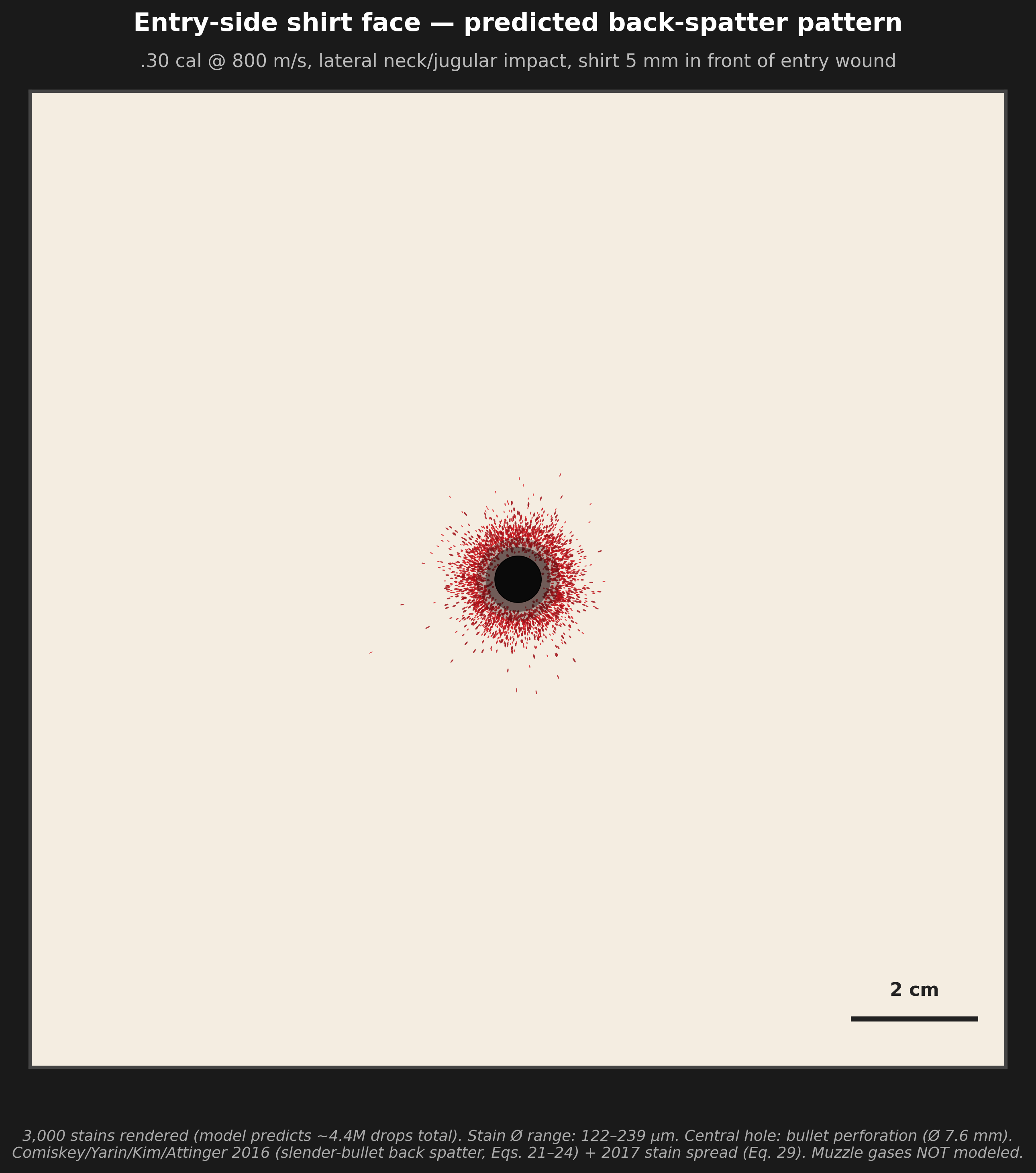
Exhibit BS-01
3,000 individually rendered stains, scaled and oriented per impact velocity and angle. Central black region: predicted bullet perforation (7.6 mm). Scale bar 2 cm.
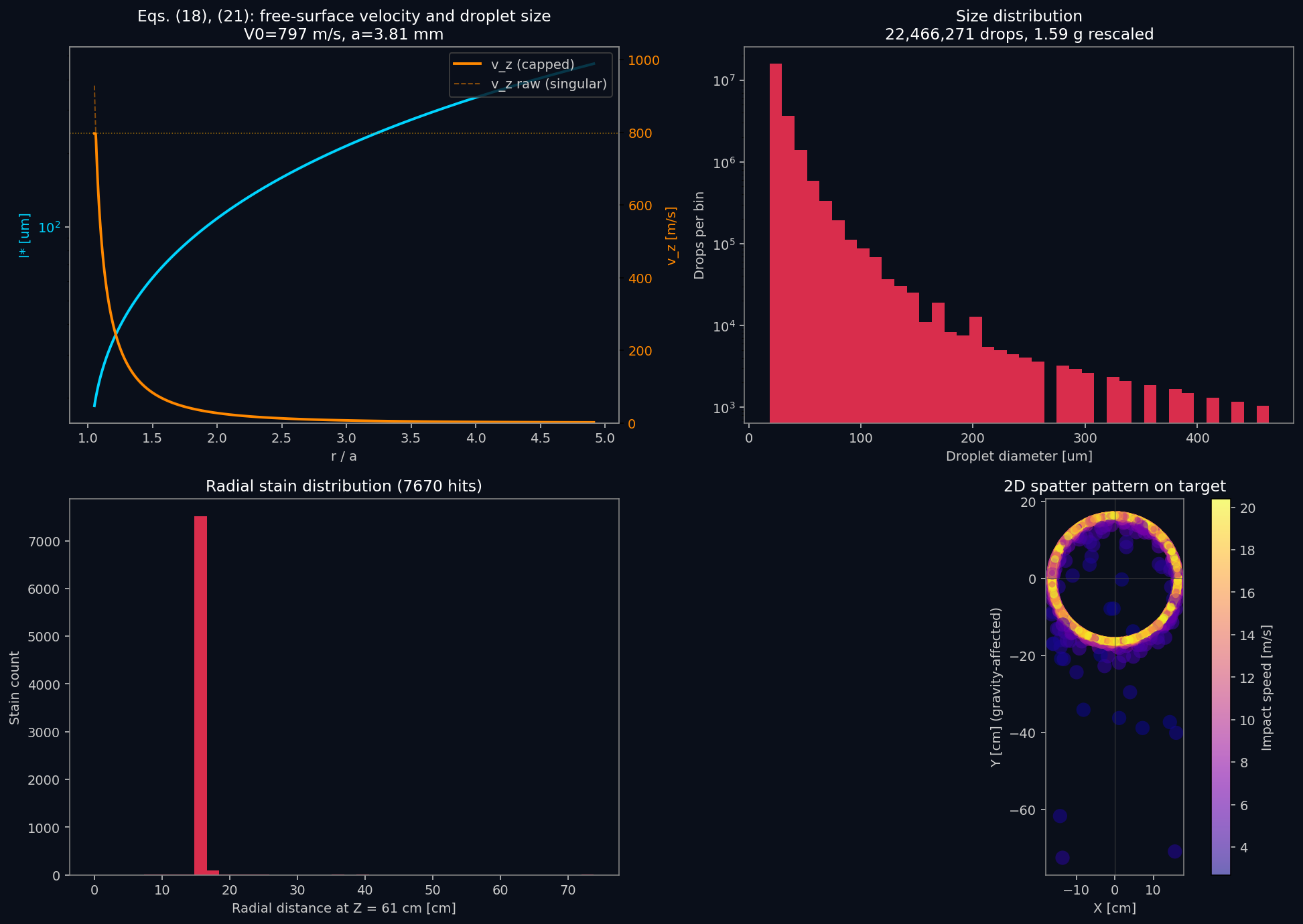
Exhibit BS-03
Multi-panel diagnostic. Peak stain density at 15.7 cm radial from bullet line. Color encodes impact speed at the backdrop.
Prediction 2 — Forward spatter
What the backdrop should have shown
~22 million drops of 19–460 μm diameter, ejected with the bullet wake in a tight ~15° cone, traversing the 61 cm gap to the backdrop.
Peak stain density at the geometric cone projection: 61 cm × tan(15°) = 16.3 cm radial from the bullet line.
The American Comeback banner and tent backdrop visible in multiple recordings should have caught the forward-spatter cone.
Prediction 3 — Bleeding onset
Torricelli flow from a pressurized vessel
For an exposed neck wound at the prosecution's stated impact parameters, photographically resolvable blood (1 mL volume on the skin) should appear within:
| Vessel | vjet | Q (mL/s) | t to 0.1 mL | t to 1 mL |
|---|
| Carotid (systolic, peak) | 5.72 m/s | 287 | 0.35 ms | 3.48 ms |
| Carotid (mean arterial) | 4.84 m/s | 243 | 0.41 ms | 4.11 ms |
| Carotid (diastolic, trough) | 4.49 m/s | 225 | 0.44 ms | 4.43 ms |
| Jugular (mean venous) | 1.42 m/s | 71 | 1.40 ms | 14.0 ms |
Expected delay to a photographically resolvable bloodstain: 1–5 ms for carotid involvement, 5–15 ms for jugular involvement.
Frame-by-frame — video2_1.mp4
What the recording actually shows
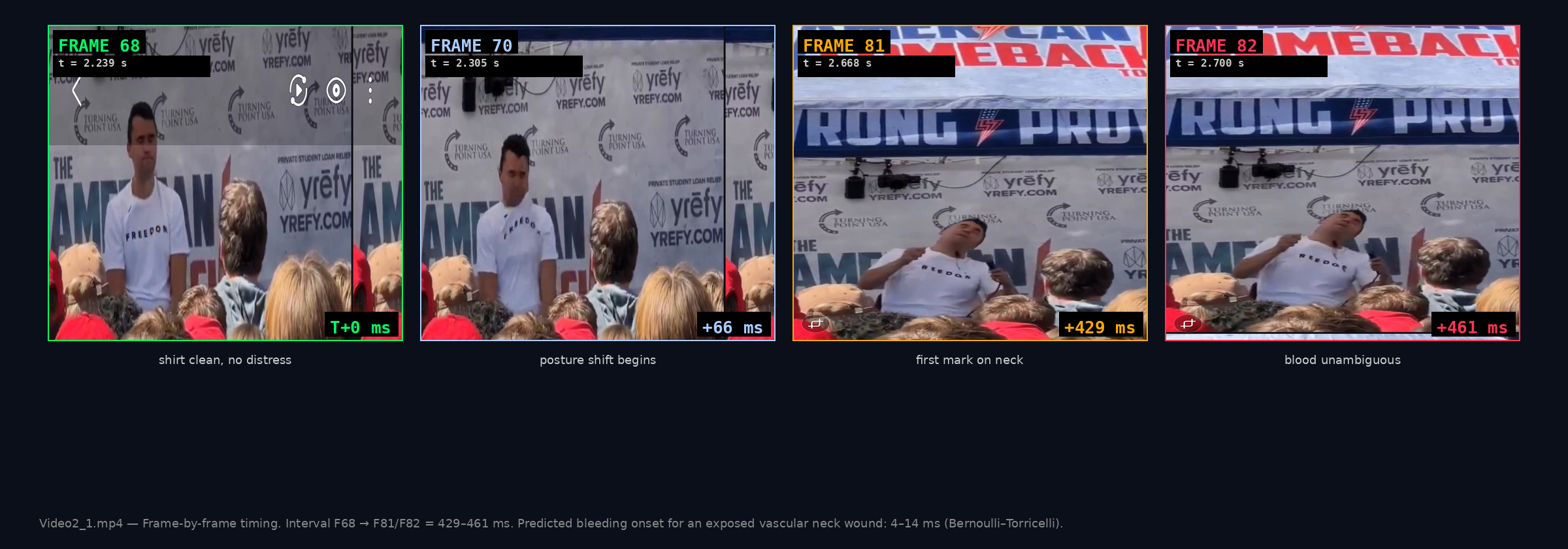
Exhibit BS-04 — video2_1.mp4 (30 fps)
Frame 68 (T+0 ms): subject seated, shirt clean. Frame 70 (+66 ms): posture beginning to shift. Frame 81 (+429 ms): first mark on neck. Frame 82 (+461 ms): blood unambiguous. Throughout, the wound site is on exposed skin with no fabric obstruction.
Observed onset interval
429–461 ms
F68 (t=2.239s) → F81–82 (t=2.668–2.700s)
Throughout the entire 461 ms window, the wound site is on exposed skin with no fabric obstruction. For an exposed vascular neck wound at the prosecution's stated impact parameters, this should not happen.
Observed vs predicted
30× — 110×
Longer than physics predicts
At a heart rate of 60–72 bpm, one cardiac cycle is 833–1000 ms. The observed delay corresponds to roughly half a cardiac cycle — a duration during which a real vascular wound would have produced visible blood within the first ~5% of that interval.
Predicted vs observed
Three independent predictions, three null observations
The physics requires
- Dense back-spatter halo on entry shirt within 1–2 ms
- Forward-spatter cone on backdrop within 1–100 ms
- Visible blood within 4–14 ms
vs.
The recording shows
- No back-spatter pattern at any frame
- No forward-spatter on banner or backdrop
- 429–461 ms to first visible blood (30–110× predicted)
All three predictions fail simultaneously. The combination is what carries forensic weight, not any one signature.
Possible explanation 1
No major vascular structure struck
If the wound channel missed both carotid and jugular, neither high-pressure jet nor venous flow is present. Visible blood would emerge only from minor capillary bleeding — on the order of mL per minute, not mL per second.
Accounts for: all three null observations simultaneously. Without a vascular reservoir to atomize, neither back-spatter nor forward-spatter can form, and there is no jet to produce rapid bleeding.
Caveat: a wound channel through the neck without striking either major vessel is geometrically possible but improbable for a high-velocity rifle round on the stated trajectory.
Possible explanation 2
Pre-existing cardiovascular arrest
If vascular pressure had already dropped to zero before the moment marked as t=0, no jet flow would occur. Blood would emerge only by gravity drainage at speeds ≤ 1 m/s, producing slow welling rather than spray.
Consistent with: the decorticate posturing observed in video2_1.mp4 between F70 and F80 — a pre-existing brain injury or other cardiovascular collapse would explain absent vascular pressure.
Implication: requires the arrest to have preceded the apparent "impact" frame, contradicting the standard rifle-shot narrative.
Possible explanation 3
t=0 is mis-identified
If "first observable shirt movement" at Frame 68 is not actually the moment of bullet impact — if it is shirt motion from a localized internal event preceding any external projectile — then 429–461 ms is not measuring impact-to-bleeding.
Consistent with: the gas-before-mechanics observation in the main analysis — gas escapes the collar one frame before any mechanical displacement. The signature of an internal energetic event, not an external strike.
Note: this explanation requires a different mechanism for the visible blood at frame 81–82; it does not by itself eliminate the wound, only relocates the cause.
Synthesis
The simplest unifying alternative
A localized internal energetic event at the RØDE Wireless PRO transmitter location, not an external projectile.
Dense optical flow
Localized expansion
Source isolated to the upper chest near the lavalier microphone — not a transit through neck tissue.
Gas-release imaging
Sudden release
Gas escapes through the collar one frame before mechanical displacement. Not a wake artifact.
Acoustic source localization
TDOA multilateration
4940 Hz Strouhal tone localized to ~3.3 m from the van — not 142 yards from the prosecution's claimed position.
Rifle round to vascular target
Three required signatures
None observed.
× × ×
A non-projectile internal event produces no bullet wake through tissue, no major vascular jet, and therefore none of the three predicted hydrodynamic signatures.
No trust required
Verify it yourself
The complete Python pipeline is downloadable below. Every parameter — impact velocity, bullet caliber, vessel pressure, standoff distance, ejected volume — is exposed at the top of the script. No hidden constants, no synthetic data, no fitted parameters. The predictions follow from the equations, the published calibration values, and the prosecution's stated impact parameters.
Comiskey, Yarin, Kim, Attinger · Phys. Rev. Fluids 1, 043201 (2016) · 2, 073906 (2017)
EPICENTER · Independent Forensic Analysis · Compiled by Jon Aaron Bray